Heritage · The migration
Coming to America.
Why they left, when, and what actually happened when they arrived.
Start with the difficulty, because everything else depends on it: nobody counts Copts.
Egypt stopped publishing religion in its census after 1986. The United States census has never asked. Every figure you will see for the number of Copts in Egypt or in America is an estimate produced by someone with a stake in it, and the estimates differ by a factor of five.
This page gives ranges and names whoever produced each one. Where the number is solid, it says so.
The waves
Six decades, forward.
- Before 1965A hundred or two people.
In the late 1950s, by the one estimate that exists, somewhere between one and two hundred Egyptians lived in the United States, almost all of them Coptic. The entire American Coptic community would have fit in a large room. Most were graduate students and physicians on training visas, and most intended to go home. The American quota system, in force since the 1920s, was built to keep people from Africa, Asia and the Middle East out.
- 1952–1961The propertied class is ruined.
Agrarian reform capped landholdings in 1952 and halved the cap in 1961. Coptic religious endowments were seized in 1957. The socialist decrees of July 1961 nationalized every private bank and insurance company, fifty shipping companies, and heavy industry. Between 1952 and 1966 some £E7 billion in assets passed to the state and incomes above £E5,000 were taxed at ninety percent.
The Coptic commercial and landowning elite was destroyed by this. Its poorer coreligionists were not — Minority Rights Group notes that land reform and nationalization initially benefited middle- and lower-class Copts. Both things are true, and an account that mentions only the first is not the honest one.
Very few left, because Egypt would not let them. Under Nasser the state heavily restricted emigration, specifically to prevent the flight of talent and of political opponents.
- 1965–1971America opens, and Egypt loses a war.
The Immigration and Nationality Act of 1965 abolished the national-origins quotas and replaced them with a system built on family reunification and professional skills, fully in effect by 1968. For a country whose old quota had been negligible, a ceiling of twenty thousand a year was not a restriction but a door.
Then the defeat of June 1967. The economy that followed it made Nasser's restrictions untenable. An estimated twenty-five thousand of the 31,358 Egyptian-born residents counted in the 1970 census were Copts.
Who left was determined by something specific, and it is the key to the whole story — see below.
- 1971–1981The door opens from the Egyptian side.
Sadat recognized emigration as a citizen's right in 1971 and lifted all restrictions on leaving. In the same period political Islam resurged, and the Migration Policy Institute states plainly that this "prompted emigration of large numbers of Egyptian Copts to Western countries."
Two events, in 1972 at al-Khanka and in June 1981 at al-Zawiya al-Hamra, are identified by the historian Michael Akladios as the moments when a scattered migration began to think of itself as a diaspora. The second was a three-day firefight that began over a mosque being built on land designated for a church: seventeen dead, nine of them Copts, and a hundred and twelve injured.
- September 1981The Pope is charged with being too Coptic.
On 3 September the arrests began; the government admitted 1,536, and independent accounts say that covers only the first three days. On 5 September President Sadat withdrew state recognition from Pope Shenouda III and confined him to the Monastery of St. Pishoy in Wadi al-Natrun. When the charges were formally specified in 1983, one of them was "emphasizing a Coptic identity."
On 6 October, Sadat was assassinated. Bishop Samuel — the bishop responsible for the overseas churches, the man who had spent twenty years building the institutional bridge that made Coptic parishes in America possible — was killed on the reviewing stand beside him.
Pope Shenouda was confined from September 1981 until January 1985, the last of the September detainees to go free.
- After 2011The only wave with hard numbers.
Egyptians granted asylum in the United States: 1,027 in fiscal 2011, 2,876 in 2012, 3,407 in 2013. In fiscal 2013 Egypt was the second-largest source of people granted asylum in America, after China.
The Department of Homeland Security does not record religion, so these are Egyptians, not Copts. But the years line up with Maspero in October 2011, where twenty-eight died and armored vehicles were driven into a crowd protesting a church burning; with August 2013, when Human Rights Watch documented attacks on forty-two churches, thirty-seven of them burned or damaged, and found that in the vast majority of cases neither police nor army were present; with the twenty-one men taken in Libya and killed in February 2015; and with Palm Sunday 2017, when bombings at Tanta and Alexandria killed at least forty-five.
Why medicine
A community locked out of one set of professions walked into another, and America happened to be hiring.
The Century Foundation's study of Christian exclusion from Egypt's security state found that of 2,510 students admitted to the military academy in 2013, thirty-two were Christian — about 1.3 percent, against a Coptic share of the population usually put near ten. There have been no Copts on the Supreme Council of the Armed Forces since 2011. In intelligence and state security the report describes a total glass ceiling. Cabinet appointments followed a pattern of rigid tokenism, typically two ministries of lesser importance.
So a Coptic graduate did not, realistically, become an officer, an intelligence official, or a senior civil servant. What was open was medicine, engineering, pharmacy, and the sciences.
Those are precisely the professions the American Immigration Act of 1965 was built to admit.
That convergence — not any single atrocity — is the engine of the Coptic diaspora in America. And the pattern is old: an economic historian working from Egyptian census manuscripts finds Christians more likely than their peers to enter medicine, pharmacy and engineering, a difference traceable to the nineteenth century and surviving the mass expansion of public education in the twentieth.
Today, sixty-seven percent of Egyptian immigrants in the United States hold at least a bachelor's degree, against thirty-six percent of US-born adults. Nearly 4,800 Egyptian-trained physicians were practicing in the United States in 2015, and Egypt is the only African country among the top ten sources of America's international medical graduates.
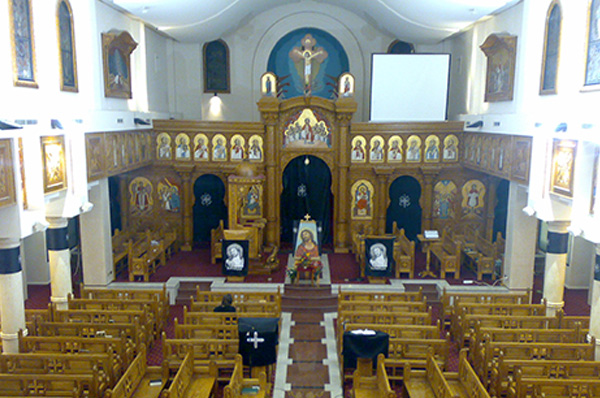
Jersey City, 1968
The women sold their gold.
By late 1968 about ten Coptic families were living in Jersey City, among them the Yanni, Banoud and Shenouda families. They worshipped in each other's apartments and in borrowed rooms.
A Protestant church building on Westside Avenue came up for sale. They negotiated the price down to $30,000, which required a deposit of $10,000, which they did not have.
The parish's own record of what happened next reads:
"Some Coptic ladies offered their jewelry for sale in order to complement the down payment."
St. Mark's, Jersey City — parish history
The first liturgy in the first Coptic Orthodox church in the United States was celebrated on 22 March 1970. Forty-four miles from here — confirm the road distance.
Why that detail is the whole story
The gold a Coptic bride wears is her own property and her own security. It is not the household's. It is hers, and it is what she has if everything else goes wrong.
The account above comes from St. Mark's own published parish history. The foundation is seeking the parish minutes to confirm it. Three sources give three names for the priest who celebrated that first liturgy, so this site does not name him.
Two churches, then two hundred and ninety-two.
In 1970 there were two Coptic Orthodox churches in the United States. There were four in North America when Pope Shenouda III was enthroned in 1971. Ten by 1976. Forty-one by 1989.
The 2020 US Religion Census counted 292 parishes and about 179,000 adherents — and found that forty-three percent of all American Coptic parishes had been founded in the previous ten years. Parishes grew seventy-two percent in that decade and adherents ninety-five percent. This is one of the fastest-growing religious bodies in the country.
New Jersey has the highest Coptic adherence rate of any state: 2.98 per thousand residents, ahead of Tennessee and more than double California's. Hudson County ranks second among all American counties by Coptic share of population. The largest Coptic parish in America by regular attendance — 1,750 people — is St. Mina in Holmdel, New Jersey.
There is one more fact, and it is the one that explains why this building belongs here. New Jersey's parishes are not in any American diocese. They fall under the Coptic Orthodox Archdiocese of North America, which answers directly to the Pope of Alexandria and is headquartered in Cedar Grove, New Jersey. Institutionally, this state is the papal see's own American ground.
Nobody knows how many.
The 2020 US Religion Census, counting people the parishes themselves report as involved in parish life, found about 180,000. Coptic community organizations estimate up to a million, counting everyone of Coptic descent including the American-born and the non-practicing.
For scale: the Census Bureau counted 323,277 people of Egyptian ancestry in the United States in 2024, and Egyptian-Americans are a mixed Muslim and Christian population. That makes a million Copts very hard to sustain arithmetically.
The truth is somewhere in between, and the gap itself is part of the story of an immigrant community — what it counts, who counts it, and what a number is for.
The honest paragraph
Zeitoun and the leaving.
The apparitions at Zeitoun ran from April 1968 to 1971. The Immigration Act took full effect in 1968. The first Coptic parishes in the United States were founded in 1970, in Jersey City and Los Angeles.
These are the same three years, and it would be easy to draw a line between them. No historian has. The foundation has looked for the scholarship and it does not exist.
What is documented is a shared cause rather than a link. Both belong to the aftermath of June 1967 — the anthropologist Cynthia Nelson, writing close to the events, dates the apparitions to roughly ten months after the Six-Day War, and the same economic collapse is what forced Egypt to let its people go.
So: in the same three years that the first Coptic parishes in America were being founded, crowds of Egyptians, Christian and Muslim, were gathering nightly outside a church in a Cairo suburb. Both belong to the years when Egyptian Copts were deciding what their future in Egypt would be. That is what can be said, and the foundation would rather say that than something larger it cannot support.
If your family's own memory connects the two
The foundation would very much like to record it. That would be new evidence, and it would be yours.
Tell us